The Quality Cost Speed Triangle Explained
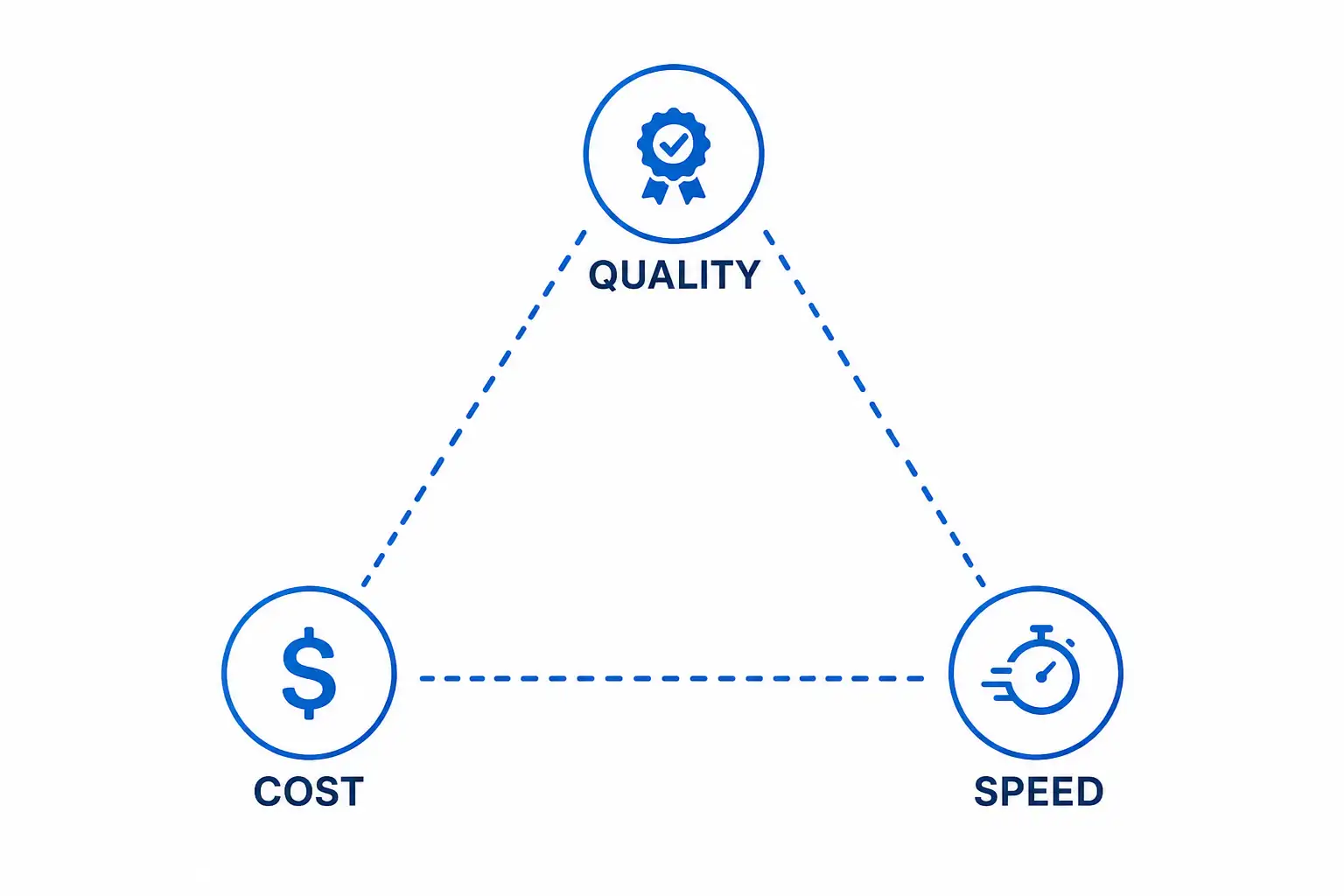
The quality cost speed triangle, also called the iron triangle or triple constraint, is the rule behind every manufacturing quote: you can optimize quality, cost, and speed (lead time), but rarely all three at once on a single order. Push for the fastest delivery and you usually pay more or accept more risk; chase the lowest price and lead time stretches or inspection thins; demand aerospace-grade quality on a rush schedule and the quote reflects premium machining and overtime. For CNC sourcing, the practical move is not to “break” the triangle. It is to name which corner is sacred on each part, use DFM to expand what is achievable, and work with suppliers who explain trade-offs honestly.
Scope note: This guide is for B2B procurement officials and manufacturing / mechanical engineers who source custom CNC machined parts. It explains the quality–cost–speed trade-off from the buyer’s side when evaluating quotes and specifications. It is not generic project-management theory divorced from outsourced precision machining.
Every RFQ eventually surfaces the same line: “We can do it fast, cheap, or right. Pick two.” That is not a sales tactic; it is the quality cost speed triangle in plain language. This guide defines each corner, why they pull against each other, how smart buyers manage the trade-off, and where teams go wrong when they ask for all three maxed out on one PO.
What Is the Quality Cost Speed Triangle?
The quality cost speed triangle maps three linked variables on every production job:
Corner | What it means on a CNC order |
|---|---|
Quality | Conformance to drawing: tolerances, surface finish, material grade, GD&T, uniformity lot-to-lot, and documentation (inspection reports, MTCs, FAIR) |
Cost | What you pay: material, machine time, setup, tooling, inspection, overhead, and margin |
Speed | Calendar time from quote or PO to parts at your door: quoting lag, material wait, queue, machining, QA release, and freight |
The core rule: change one corner and the other two move. More speed without budget usually means premium capacity or less margin for careful setup. Lower cost without more time usually means thinner inspection, cheaper material paths, or wider process windows. Higher quality on a fixed deadline almost always costs more.
Where Does the Iron Triangle Come From?
The idea started in project management as scope, cost, and time, with quality as the outcome. In manufacturing, once design is fixed, scope becomes specifications (dimensions, tolerances, material, finish, function), time becomes lead time, and cost stays cost. The “iron” label means the constraint is structural: better machines and leaner shops shift the triangle outward over time, but on any single order you still face trade-offs. DFM, automation, and stocked materials can improve all three dimensions together, but they do not erase physics on one impossible RFQ.
What Does Quality Mean for CNC Parts?
Quality on precision CNC work is measurable, not vague branding.
Dimensional tolerance: Features held to the bands on the drawing; see CNC Tolerances Guide and ISO 2768 Tolerance Charts.
Surface roughness: Ra or Rz on functional surfaces; see Surface Roughness Ra, Rz & Rms Explained.
Material grade: Correct alloy, traceability, and MTC where required.
Geometric control: Flatness, position, parallelism when GD&T applies.
Lot uniformity: Every piece matches the approved sample, not only the first off the machine.
Documentation: Dimensional reports, FAIR, certificates of conformance. Higher quality bands mean slower feeds, more inspection, tighter fixturing, and sometimes secondary ops (grinding, honing), which pull against cost and speed.
What Drives Cost on a CNC Order?
Cost stacks in layers; cutting one layer usually hits quality or speed.
Cost layer | What it includes |
|---|---|
Material | Grade, market price, certification, traceability |
Machine time | Spindle hours at shop rate |
Labor and setup | CAM, fixturing, tool changes, skilled operators |
Tooling | Cutters, inserts, special tools, fixture amortization |
Quality control | CMM time, FAIR prep, inspector labor |
Overhead and margin | Facility, energy, supplier profit |
“Cheaper” often means cheaper stock, faster setups with less optimization, skipped secondary finishing, or lighter inspection: each with a quality or lead-time consequence.
Why Is Faster Lead Time Never Free?
Speed is lead time end to end, not cycle time on the machine alone. Accelerating delivery typically requires:
Premium machine or shift capacity (higher cost)
Expedited material with surcharges (cost)
Shorter setup windows with less process tuning (quality risk)
Deferred or sampled inspection (quality risk)
Queue jumping that strains the shop’s other commitments (cost to the supplier, often passed through)
That is why rush lines on CNC quotes are real. The supplier is reallocating capacity, not just pressing “go faster.” For where waiting actually hides, see How to Reduce CNC Lead Time.
Why Can't You Maximize Quality, Cost, and Speed Together?
On one order, full optimization of all three corners is usually impossible. The classic combinations:
If you prioritize… | You typically get… | You give up… |
|---|---|---|
High quality + high speed | Premium quote, overtime, tight process control | Low unit cost |
High quality + low cost | Careful setup, standard feeds, full inspection | Short lead time |
High speed + low cost | Corners cut on setup, inspection, or tolerance hold | Quality margin: highest defect risk |
A request for “fastest lead time, lowest price, and aerospace tolerances” on the same bracket is not a negotiation opener. It signals a mismatch with manufacturing reality. Capable suppliers will say so; vague yes-men are the risk.
How Should Buyers Manage the Trade-Off?
You cannot abolish the triangle, but you can manage it deliberately.
1. Choose which corner is sacred
Decide what cannot move for this part:
Medical or safety-critical → Quality fixed; cost and speed flex.
Trade-show prototype → Speed fixed; pay more or relax non-critical tolerances.
High-volume consumer bracket → Unit cost fixed; plan schedule early to avoid rush fees. Tell the supplier which corner is fixed. Without that, they guess, and you may get the wrong guess.
2. Use DFM to expand the whole triangle
The best escape from “pick two” is not wishful thinking. It is better design. Simpler geometry, standard tools, feasible tolerances, and fewer setups improve speed, cost, and quality risk together. Run a DFM pass before you freeze the drawing. See our Design for Manufacturing (DFM) Guide. On Sattardas, uploading a STEP file to the instant quote flow shows how material, tolerance, finish, and inspection choices move price and lead time on your actual geometry, so you see the triangle shift before you lock the PO, instead of discovering the trade-off after a week of email RFQ.
3. Match tolerances and finish to real function
Over-tightening every dimension (e.g. blanket fine class on ISO 2768 when medium suffices) raises cost and lead time with no functional gain. Tighten only mating, locating, and performance surfaces, a core theme in the CNC Tolerances Guide.
4. Build schedule buffer: don't force quality at the deadline
Projects that drift early often crash at the end: ship late or ship questionable parts. Realistic buffers protect the quality corner when speed was never truly sacred.
5. Prefer suppliers who explain the trade-off
Walk away from vendors who promise cheapest, fastest, and tightest without caveats. Strong partners state what moves when you pull on cost or calendar: that honesty is itself a quality signal. Vetting approach: How to Choose a Manufacturing Supplier.
What Do Quality Cost Speed Trade-Offs Look Like in Practice?
Scenario | Sacred corner | Typical trade-off |
|---|---|---|
Aerospace bracket with FAIR and MTC | Quality | Higher unit cost; longer lead for inspection and documentation |
Trade-show enclosure prototype in five days | Speed | Rush pricing; slightly looser non-critical tolerances acceptable |
50,000-piece aluminum bracket | Cost | General tolerance class; schedule planned ahead, no last-minute rush |
Same triangle, different fixed corner. The discipline is naming it per program.
What Mistakes Do Buyers Make With the Triangle?
Treating lowest price as best value: A quote far under peers often sacrifices inspection, material grade, or realistic lead time.
Rush delivery without budget: Compressed lead time has a cost; “rush, same price” usually hides a quality or scope compromise.
“Tighten everything to be safe”: Vanity tolerances and blanket fine Ra inflate cost and calendar without engineering benefit.
Not stating which corner matters: Suppliers default to their own guess; you may not like the result.
Ignoring failure cost: Cheap-and-fast parts that fail in assembly or field service cost more than a honest quote upfront.
How Sattardas Makes Quality Cost Speed Trade-Offs Visible
Sattardas is an on-demand precision CNC platform with instant quotations. Upload a STEP file, get price and DFM feedback in minutes, manufactured in India and delivered DAP to your door in Europe and the USA. Instead of a black-box RFQ where trade-offs surface after days of email, you parameterize the order: material, tolerance band, surface finish, inspection level, documentation, and see how each choice moves cost and lead time on the same part. That supports conscious triangle management: fix quality for a regulated build, or explore speed and cost on a prototype, with numbers before you commit. Integrated MTC, CMM reports, and FAIR options are quoted upfront so the quality corner is not “added later” as a surprise line item or calendar hit.
Frequently Asked Questions
Can you have high quality, low cost, and fast speed on the same CNC order?
Not fully on one PO: that is what the triangle describes. Over time, DFM, better tooling, and capable suppliers expand what is achievable, but each individual order still involves trade-offs.
Which corner should a buyer prioritize first?
It depends on the part: regulated or safety-critical → quality; deadline-driven prototype → speed; high-volume commodity → unit cost. The mistake is not choosing. It is expecting all three maxed without saying so.
How does supplier choice affect the triangle?
A skilled, well-equipped partner operates on a larger triangle: better outcomes on all three axes for the same spec: than an under-capacity shop. Cheap quotes from weak suppliers often shrink two corners while advertising the third.
Is the triangle only about manufacturing?
The same logic applies across design and sourcing: material choice, tolerance strategy, and inspection level set your position on the triangle before metal is cut.
How can I see trade-offs before I place a CNC order?
Use a platform that prices tolerance, material, finish, and lead time as explicit parameters. On Sattardas, changing options on the instant quote updates price and delivery in real time, so you manage the triangle with data, not assumptions.
Conclusion
The quality cost speed triangle is the simplest framework in manufacturing sourcing, and one of the most ignored. Fast, cheap, and perfect on one line item is a red flag, not a win; rush without budget invites quality risk; the lowest quote often becomes the most expensive after rework. Winning buyers pick the sacred corner per part, use DFM to widen what is possible, match tolerances to function, and partner with suppliers who explain what moves when. Manufacturing does not reward breaking the triangle. It rewards using it deliberately.